Brain Fatigue After Stroke: My First Experiment
Understanding Brain Fatigue without Science
I’m not a scientist.
I see complicated words and I then forget them.
What I am is a curious person.
Brain fatigue after stroke is part of my life.
I am trying to understand how my new brain works.
I want to learn how I can change my activities so that my brain works better, feels stronger—and so I can live a meaningful life.
From August 5 – 13, I did an experiment.
Each day, I watched:
- Sleep
- Tasks
- Time
- Brain fatigue
- Talking
- Other things I noticed
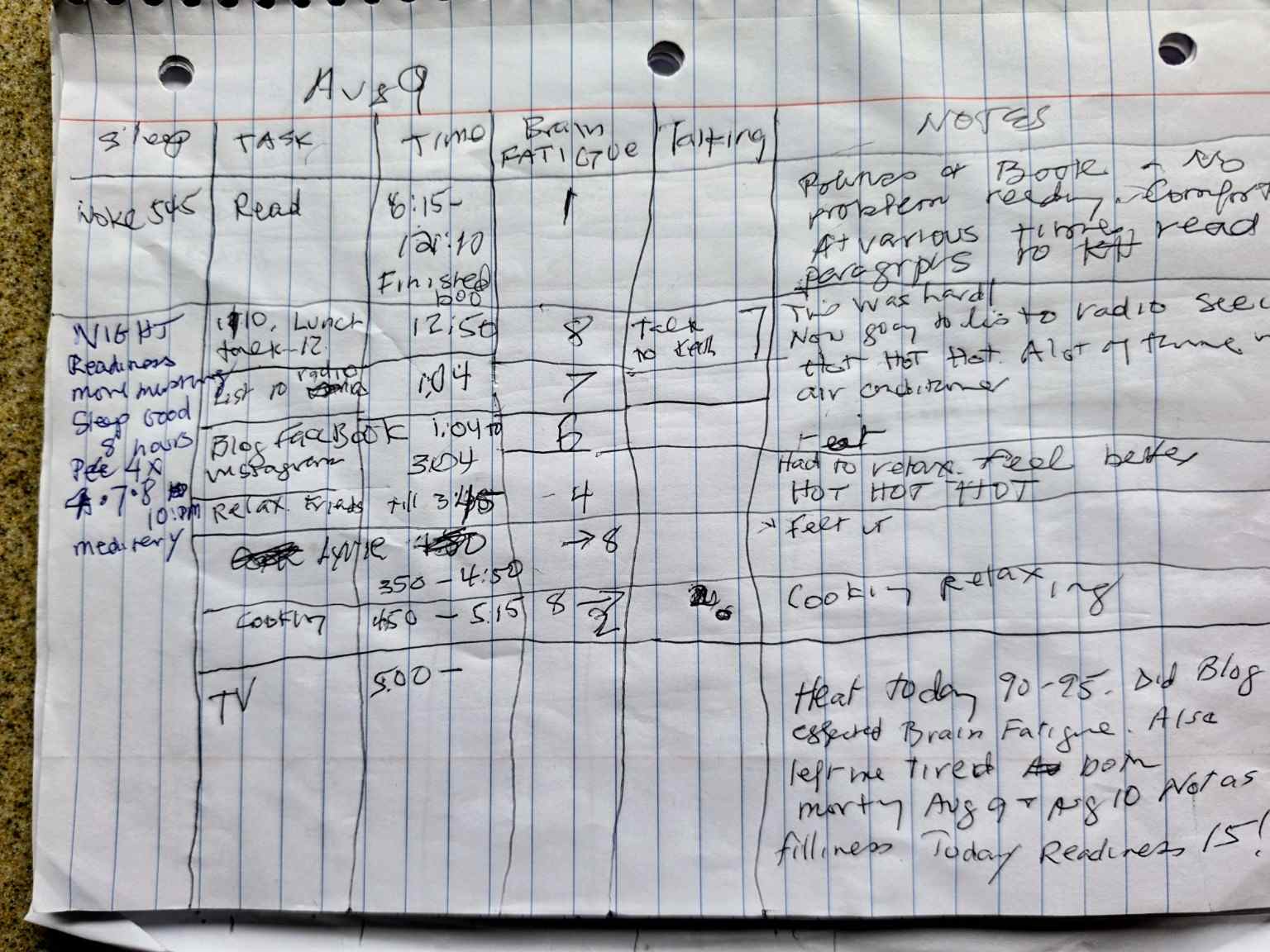
One page from my brain fatigue experiment, tracking daily activities and how my brain responded.
My goal wasn’t to create something for a high school or college class.
I simply wanted to discover how my brain felt. Then I wrote it down.
What felt good?
What felt bad?
What surprised me?
And what should I do about it?
My experiment was personal, not scientific. But the American Stroke Association and National Aphasia Association recognize that fatigue after stroke and aphasia can affect communication, daily activities and returning to work.
What did Brain Fatigue feel like?
For four years I’ve had brain fatigue almost every day. The right side of my head, above my eyebrow, begins to ache. When the fatigue gets worse, I sometimes feel nauseated.
For years, brain fatigue simply happened. Until this experiment, I had never tracked when it appeared or tried to understand what I could do about it.
What Increased it?
- Working too long on projects that required me to understand information, make decisions and take action—especially with technology, arguing with Amazon, spending too much time writing or figuring out social media projects.
- Long one-on-one conversations.
- Controversial television programs.
- Reading a book, letter or long paragraph. I call this old-fashioned reading. My eyes see the written words, and my brain has to turn those words into meaning. I do this by myself, using only my eyes and my brain.
What I didn’t realize until last week was that heat hurt my brain. It was even more challenging than projects. The entire week was hot — between 82 and 95 degrees in Connecticut.
Outside I became exhausted. Tired. Inside air conditioning wasn’t available in my kitchen or dining room and office.
In those rooms all I had was fans.
I could begin the day feeling fine. Then I’d spend time in the hot kitchen or dining room and do a difficult task — like writing an email, calling a doctor’s office or solving a technology problem — the ache above my right eyebrow appeared, I’d feel kind of nauseous.
In heat, once it started, it stayed even after I stopped working. My brain didn’t recover quickly.
What Didn’t Cause Fatigue?
I also had consistent reactions to the following activities. No fatigue at all:
- Walking (unless it was brutally hot)
- Physical therapy
- Playing the ukulele
- Cooking
- Reading using Text-to-Speech (TTS). TTS allowed me to see the words and hear them at the same time. (Here is a good description “How Text-to-Speech Aids Reading for People with Aphasia“.
- Short conversations
- Group conversations where I listened and talked less
- Short, fun TV. During the experiment I watched Friends.
This told me that activity didn’t cause fatigue.
Instead it hurt when I had problems … when conversations were tense, difficult or controversial.
How Sleep Helped
For the past three months, I had been trying to improve my sleep.
I started going to bed earlier.
I watched easy going television …
Practiced 4-7-8 breathing and spent time meditating.
If I woke up at 2:30 am, I left the bedroom and listened to Friends for about 30 minutes. Then I went back to bed, practiced 4-7-8 breathing and mindfulness, and fell asleep again.
During my experiment, I noticed that these changes were helping.
Better sleep did not solve everything. Heat and difficult projects could still create brain fatigue. But sleeping better gave me a stronger start to the day.
What the Experiment Taught Me about Working and Retirement.
I retired in 2020, when I was 68 years old. Two years later, I had my stroke.
For several years afterward, I often told Keith that working would be incredibly difficult.
At first, I thought maybe I could work in a grocery store. Later, when I began writing again, I wondered whether I might be able to write for work if I had to.
But my experiment helped me understand something I had never quite recognized before.
Brain fatigue would have made working especially hard.
Writing, technology and conversations are possible for me. The problem comes when I have to keep going after my brain tells me to stop.
Now I understand that I can still do things I enjoy. I just need to listen to my brain, take breaks and let myself relax.
What I’m Changing
My experiment was not scientific, but it helped me understand how to make life easier for my brain.
Instead of pushing forward when brain fatigue kicks in, I stop. I spend time relaxing or doing something easy. Normally I would go for a little walk but that didn’t work last week in the brutal heat so I did other things:
- Use text-to-speech and read.
- Clean the kitchen or do another easy activity.
- Break technology projects into small steps.
- Avoid several difficult tasks on the same day.
- Keep long conversations shorter or take breaks.
- Choose easy, short television before bed.
- Limit political news to half an hour in the morning.
- Pay attention to heat and spend more time in air-conditioned rooms.
- Continue cooking, walking and physical therapy when conditions feel comfortable.
- Write for enjoyment. Publish when I want to … not because it’s required.
- Play the ukulele and practice tai chi. They’re both fun. The ukulele is good for the brain. Tai Chi is good for my body.
I do not need to stop using my brain.
I need to learn which activities tire it,
which activities support it,
and when it’s time to stop.
LEARN MORE
The American Stroke Association and National Aphasia Association recognize that fatigue after stroke and aphasia can affect communication, daily activities and returning to work.
Everyday Brain: Learning How to Work With the Brain I Have
Also look at: Everyday Brain: Getting to Know My New Brain
Visit Aphasia at Home for practical ideas about brain health, stroke recovery, aphasia, and everyday life.